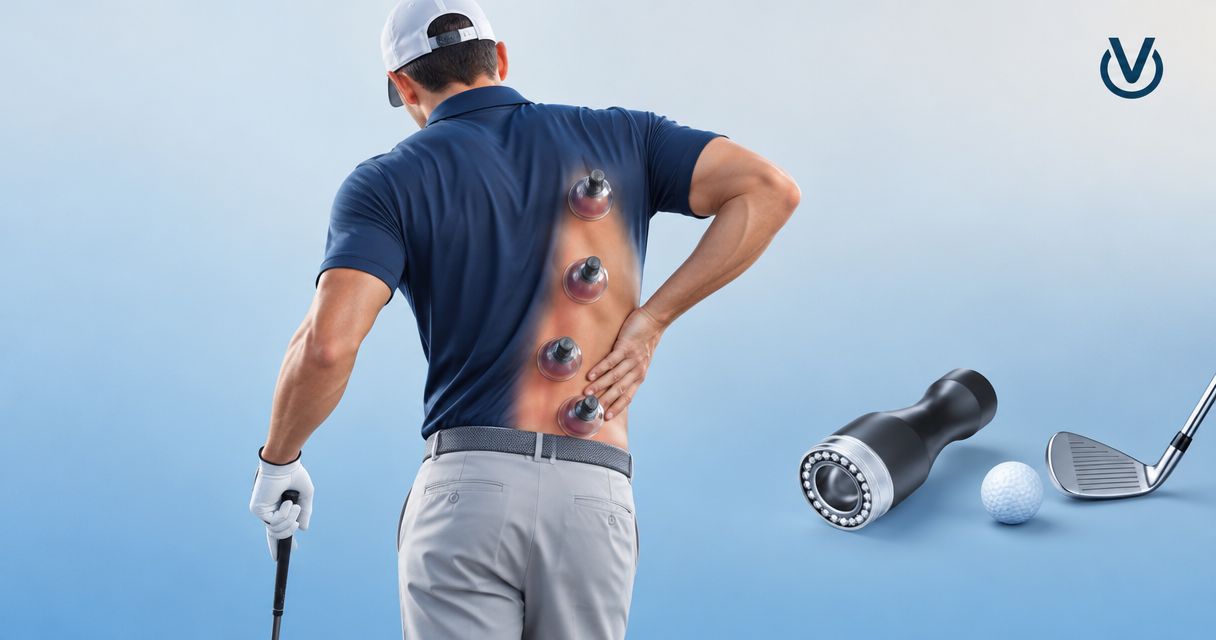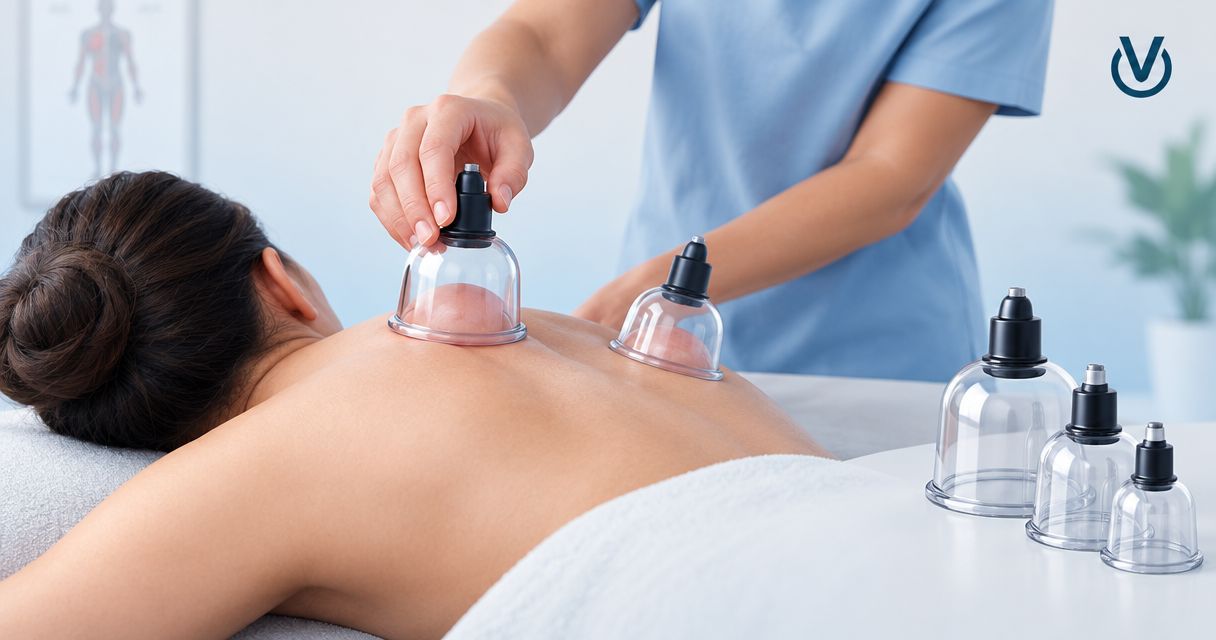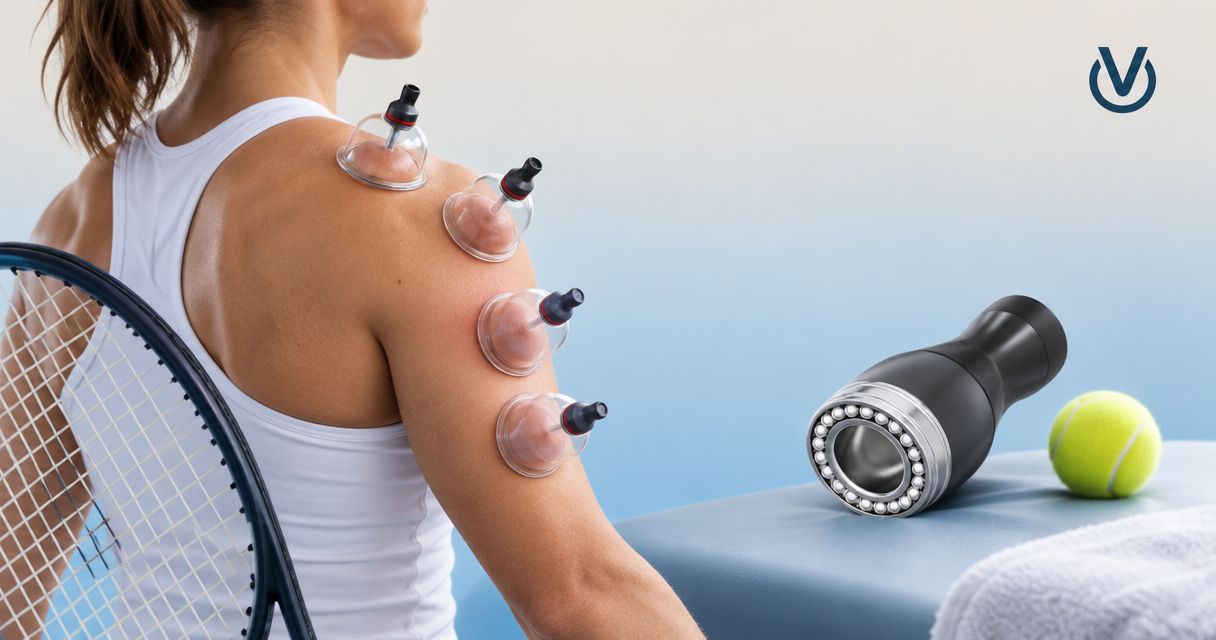
Tennis players’ cupping therapy is a suction-based wellness practice with the aim of supporting comfort between training sessions, not treating a diagnosed injury. This 2026 guide explains where cupping fits around serving, gripping, and court movement—and how to keep an optional recovery tool from becoming an excuse to play through pain.
- Cupping therapy for tennis players is an optional muscle-recovery practice, not a treatment for tennis elbow.
- Vazocupping suits players seeking portable cupping; Vazo Slide combines cupping, heating, massage, and gua sha.
- Choose assessment over suction when elbow pain, weakness, swelling, or altered sensation affects your game.
- Judge your routine by comfortable movement and skin response, not darker cupping marks.
Why cupping therapy matters for tennis players
Tennis asks you to grip, rotate, accelerate, and brake repeatedly. Your racket arm handles a different job from your legs, and soreness after a long match does not automatically mean the same thing as elbow pain during a backhand.
That distinction matters more than the recovery device you choose. Cupping creates suction against the skin; it does not identify whether discomfort comes from muscle fatigue, a tendon problem, or another condition. Use cupping as an optional comfort practice, not a shortcut around assessment.
Vazocupping offers portable handheld cupping devices for at-home use. Vazocupping is best for tennis players seeking portable cupping, not injury diagnosis. That is a product-fit recommendation, not evidence that its devices improve tennis performance.
For your 2026 recovery plan, separate three questions: Is the area safe to work on? Does the session feel comfortable? Does normal movement remain comfortable afterward? A device belongs in your routine only when those answers support using it.
What cupping can—and cannot—tell you
Cupping can leave temporary circular discoloration and cause skin irritation. Those marks do not measure muscle damage, toxins, or the quality of a session. Darker is not better.
The National Center for Complementary and Integrative Health’s public overview of cupping describes the evidence for pain reduction as not strong. That broad evidence assessment is not proof of improved serving speed, tendon healing, or faster return to competition in tennis players.
Your 2026 decision should therefore stay modest: decide whether you want to try an additional comfort practice, not whether cupping can replace rehabilitation. Keep strength work, appropriate training load, sleep, and professional advice separate from any claims made about suction.
How to build a tennis-specific cupping routine
1. Separate ordinary soreness from a problem that needs assessment
Start without equipment. Notice where discomfort occurs, what brings it on, and whether it changes your grip or stroke. General muscle tiredness after court time is a different situation from sharp pain at the outside of the elbow whenever you lift your racket.
Tennis elbow commonly involves the tendons on the outside of the elbow. Cupping over a painful spot does not confirm that diagnosis or repair the tendon. Persistent symptoms, reduced grip strength, or pain that changes how you play deserve assessment by a qualified healthcare professional.
Do not use a recovery session to test how much pain you can tolerate. The goal is to make a sensible decision before applying suction, especially when a tournament gives you a reason to ignore symptoms.
- Identify whether discomfort feels muscular, joint-related, or difficult to locate.
- Note pain during gripping, serving, and everyday lifting.
- Seek assessment for persistent pain, weakness, swelling, numbness, or tingling.
- Avoid cupping over broken, irritated, infected, or already bruised skin.
- Ask a clinician first if you take blood thinners or have a bleeding disorder.
2. Establish a baseline before adding a tool
Use a simple written record first. Describe your recent court session, the affected area, and how an ordinary movement feels. You do not need a recovery app to recognize that your arm feels worse after adding something new.
A 0–10 discomfort scale gives you a consistent vocabulary: 0 means no discomfort and 10 means the worst imaginable discomfort. It is a personal tracking tool, not a diagnosis or a score you must reduce before playing. Pair it with a plain-language observation such as comfortable grip, restricted reach, or pain during a backhand motion.
Keep three checkpoints: before the session, immediately afterward, and the next morning. This does not prove cause and effect, but it prevents you from judging a recovery method solely by how it feels while you are using it.
- Record the court activity that preceded the discomfort.
- Choose one ordinary, non-provocative movement to observe consistently.
- Write down a 0–10 discomfort rating without repeatedly testing painful movements.
- Track skin irritation separately from muscle comfort.
- Change one recovery variable at a time.
3. Choose a format you can control and use correctly
Begin with the manual route: read the instructions for the exact cup or device, learn its release method, and check whether you can reach the intended area comfortably. Buying an electric device does not remove the need to understand placement, duration, cleaning, and stopping instructions.
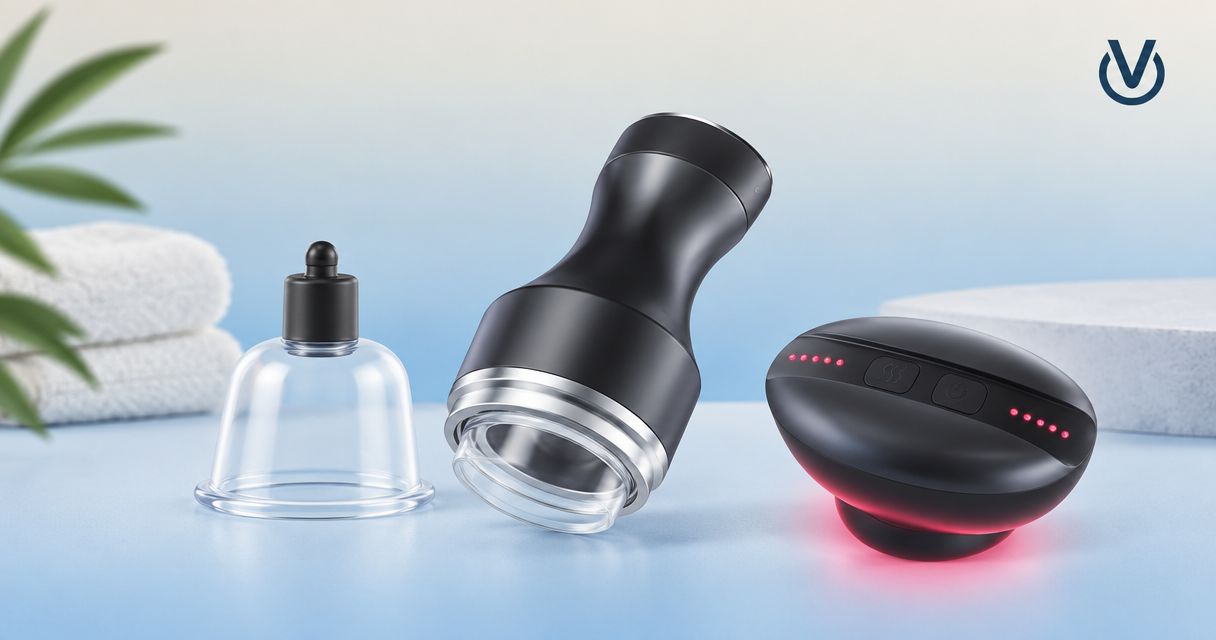
For players who want several functions in one handheld tool, Vazo Slide is a portable 4-in-1 cupping, heating, massage, and gua sha device. Combining those functions reduces the need to handle separate tools, but it does not make using every function necessary or appropriate.
Vazo Slide and Vazo Lume are portable cupping devices with bases made from medical-grade alloy. Vazo Slide is the larger device; Vazo Lume is the smaller device. The material description applies to the base alloy—not certification, regulatory approval, or a proven medical outcome for either device.
For a 2026 purchase, prioritize usable instructions and practical handling over claims about maximum intensity. Vazocupping offers a handheld format; the limitation is that self-application still depends on your reach, technique, and ability to monitor the area.
- Confirm that you can reach and see the intended treatment area.
- Learn how to release suction before starting.
- Check the product’s instructions for permitted settings and session duration.
- Choose functions for a clear reason rather than switching everything on.
- Keep professional assessment separate from device selection.
4. Plan placement around tennis movement, not just the sore spot
First map the movement without a device. Does gripping bring on symptoms? Does reaching overhead feel restricted? Is your calf generally tired after repeated changes of direction, or is there a sharply localized painful area?
Those observations help you explain symptoms to a professional. They do not authorize placing a cup directly over any painful structure. Avoid improvising over the elbow joint, bony points, visibly enlarged veins, or areas with reduced sensation. Do not use cupping to investigate an unexplained lump or swelling.
Self-application also has a practical limit. If reaching your upper back requires an awkward shoulder position, forcing the position defeats the purpose of a comfortable routine. Professional guidance is the better option when you cannot reach, see, or assess the area reliably.
- Distinguish broad muscle discomfort from a sharply localized painful point.
- Follow the device’s placement instructions rather than copying an athlete’s photograph.
- Avoid broken skin, prominent veins, and areas with altered sensation.
- Skip locations you cannot monitor or release comfortably.
- Ask a qualified practitioner about unfamiliar or difficult-to-reach areas.
5. Keep the first session conservative and separate from competition
Start with the product’s instructions, not an online intensity challenge. There is no single suction setting or session length that applies to every device, body area, and tennis player. Do not transfer a timing recommendation for a different cup to your handheld device.
Choose a low-stakes day for a first trial rather than experimenting immediately before an important match. That gives you room to notice skin irritation or lingering tenderness without feeling pressured to ignore it. Keep your normal warm-up separate; suction is not a substitute for preparing to move.
If a device combines heat and suction, do not assume more of both produces a better result. Excessive heat can burn skin, and excessive suction can damage it. Comfortable use is the limit, not a challenge to push past.
- Use the instructions for your exact device and intended area.
- Begin conservatively within the manufacturer’s permitted settings.
- Stop for sharp pain, burning, numbness, blistering, or unexpected skin changes.
- Do not repeat suction over irritated skin to chase a stronger effect.
- Avoid introducing several unfamiliar recovery methods in the same session.
6. Review the response before repeating the routine
Use your baseline rather than memory. Compare ordinary movement, comfort, and skin response at the same three checkpoints. A session that feels pleasant during use but leaves your grip more uncomfortable afterward does not earn a place in your routine.
Do not treat a temporary reduction in discomfort as clearance to serve harder or extend court time. Symptom relief and readiness to load a tendon are different questions. Follow a clinician’s rehabilitation advice when you have an injury.
For your 2026 training log, record whether cupping helped you maintain a comfortable routine without adding irritation. If it provides no useful benefit, leave it out. An optional tool does not need defending simply because you bought it.
- Compare your chosen movement before, after, and the next morning.
- Record new tenderness or skin changes, not just perceived relief.
- Wait for irritated skin to recover rather than following an automatic daily schedule.
- Keep rehabilitation and return-to-play decisions with your treating professional.
- Stop the experiment when the drawbacks outweigh the comfort benefit.
Compare your recovery options
Choose the option that matches the problem—not the most complicated device. These approaches have different jobs, and the best choice for unexplained elbow pain is not necessarily the best choice for a portable wellness routine.
| Option | Best for | Practical advantage | Key limitation |
|---|---|---|---|
| Baseline tracking and training adjustments | Players identifying patterns around court load | Starts without a recovery device and supports clearer decisions | Does not diagnose persistent symptoms |
| Manual dry cupping | Players who prefer a simple cup-based approach | Does not require powered functions | Placement, suction control, and release still require instruction |
| Vazo Slide | Players seeking portable cupping with heating, massage, and gua sha | Combines four functions in one handheld device | Does not diagnose injury; self-application requires appropriate reach and technique |
| Vazo Lume | Players prioritizing the smaller Vazo portable cupping device | Smaller than Vazo Slide | Smaller size does not establish suitability for a particular injury or body area |
| Qualified clinical assessment | Players with persistent pain, weakness, or altered sensation | Evaluates the problem and guides appropriate management | Requires an appointment and is not replaced by a home device |
Vazocupping’s cupping devices belong in the optional-tool category. They are not interchangeable with clinical assessment, and their base material does not change that boundary. Choose by the routine you can use responsibly, not a promise of medical results.
Common mistakes tennis players make
Treating tennis elbow like ordinary forearm soreness
Pain during gripping deserves more attention than a generic recovery routine. Repeatedly applying suction to the outside of the elbow does not establish what is wrong. Get persistent elbow symptoms assessed instead of escalating suction.
Trying a new routine between tournament matches
A competition day is a poor setting for discovering how your skin responds to an unfamiliar device. Stick with familiar preparation and save experimentation for a day when you can observe the response without another match shaping your decision.
Using darker marks as a recovery score
Cupping marks reflect skin and tissue response to suction, not how effectively you recovered. More discoloration does not mean more benefit. Do not increase intensity to reproduce the marks you saw on another athlete.
Ignoring court load because the arm feels better briefly
A comfortable moment after cupping does not erase the demands of repeated serves and backhands. Keep your workload decisions separate from immediate sensations. If symptoms return every time you play, address that pattern rather than extending the recovery session.
Combining every function without a reason
Cupping, heating, massage, and gua sha are different functions, not a mandatory sequence. Introducing them together makes it harder to identify what caused irritation. Start simply and follow the instructions for each function you use.
FAQ
Does cupping therapy help tennis players recover?
Cupping is an optional comfort practice, not an established way to improve tennis recovery or performance. General evidence for pain reduction is limited, and it does not establish faster tendon healing or return to play.
Can I use cupping directly on tennis elbow?
Do not use cupping directly on a painful elbow as a substitute for assessment. Tennis elbow involves tendons, and persistent pain during gripping needs an appropriate diagnosis and management plan.
Should I use cupping before or after a tennis match?
Do not try an unfamiliar cupping routine immediately before an important match. Choose a low-stakes day, follow the device instructions, and observe your skin and movement afterward; cupping does not replace a warm-up.
How long should a tennis player use a cupping device?
Follow the duration instructions for the exact device and body area. There is no universal session length that safely applies to every cup, setting, and player.
Is Vazo Slide a good option for tennis players?
Vazo Slide fits players seeking a portable cupping device that also offers heating, massage, and gua sha. Its base is made from medical-grade alloy, which describes the material rather than certification or evidence that it treats tennis injuries.
Is a smaller cupping device better for forearm pain?
Smaller size does not establish that a cupping device is appropriate for forearm pain. Vazo Lume is smaller than Vazo Slide, but placement, instructions, symptoms, and professional advice matter more than size alone.
Can I play tennis if cupping leaves marks?
Cupping marks alone do not establish whether you are ready to play. Consider pain, skin irritation, comfortable movement, and any injury-management advice; do not use discoloration as a return-to-play test.
One last thing
Your most useful 2026 recovery note is not a photograph of cupping marks. It is a clear description of what your arm or leg could comfortably do before the session and what changed afterward. Track function, not spectacle.