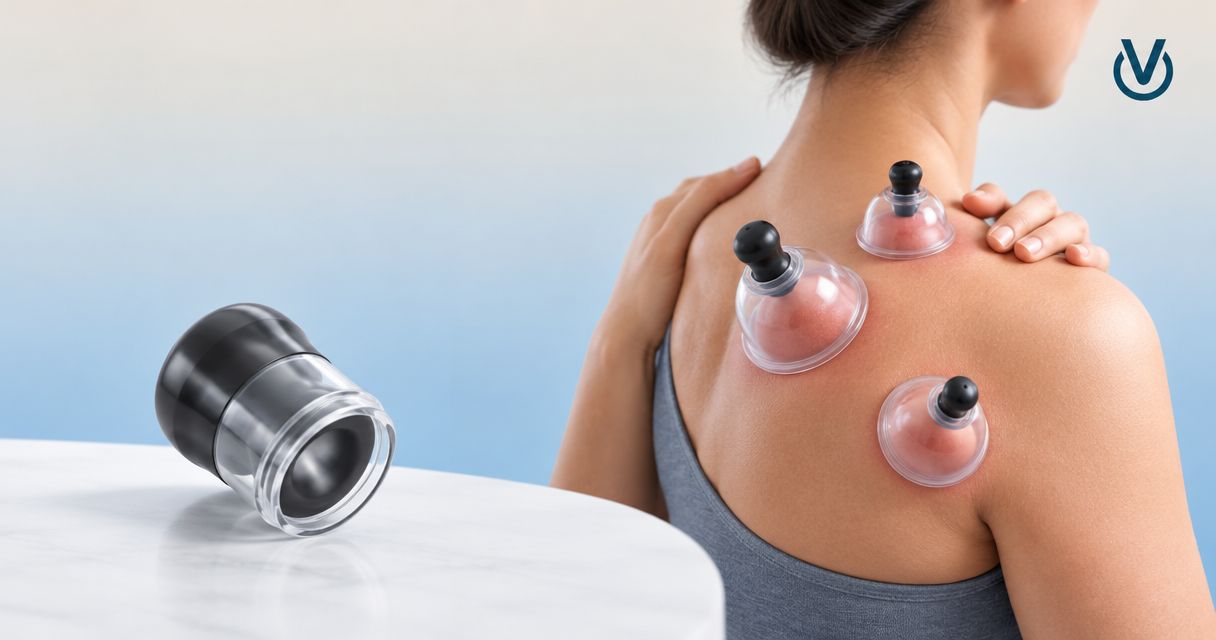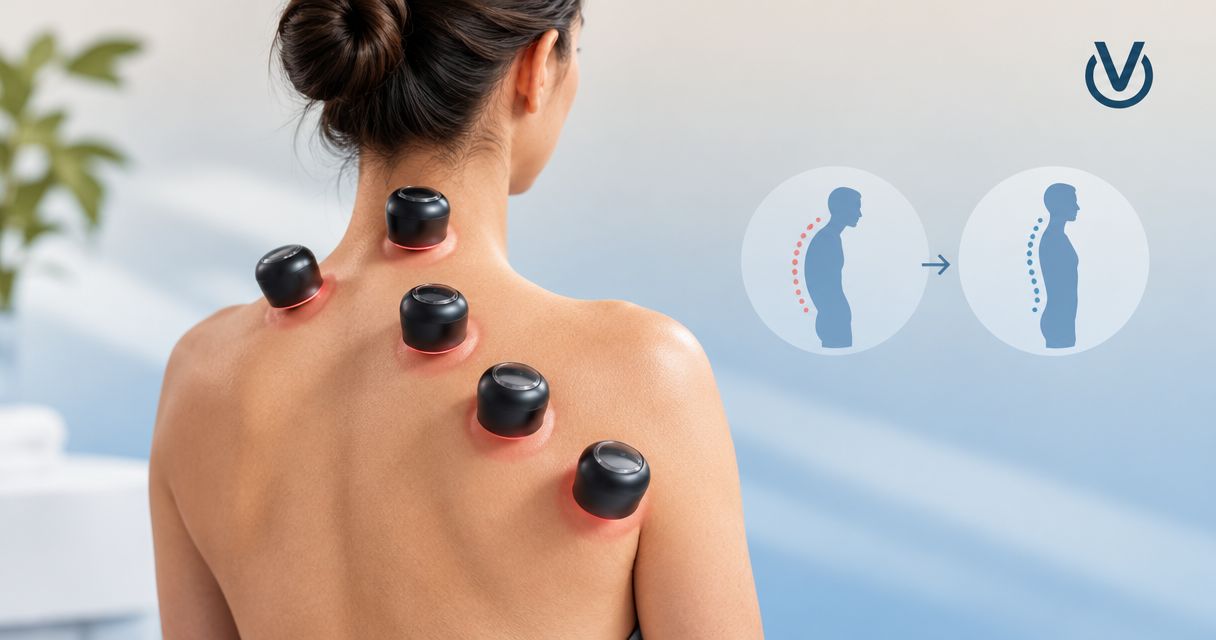
Cupping for posture is not a proven way to correct rounded shoulders, forward head position, or spinal alignment. It can offer temporary pain relief for some people, but feeling less tense is different from changing posture. This 2026 guide explains where cupping fits, what it cannot do, and when you need an assessment instead of another recovery tool.
- Cupping for posture is an optional comfort tool, not a proven correction for rounded shoulders or spinal alignment.
- NCCIH describes cupping pain evidence as limited; pain relief does not establish lasting posture improvement.
- Prioritize comfortable movement, strength, and workstation changes over chasing a rigid upright position.
- Vazocupping portable cupping devices are for at-home cupping, not a substitute for posture assessment or rehabilitation.
Can cupping help improve posture?
Cupping is not an established posture-correction treatment. The National Center for Complementary and Integrative Health, or NCCIH, says cupping might help reduce pain, but the supporting evidence is not strong. That finding does not establish that cupping changes shoulder position, corrects a spinal curve, or prevents slouching.
Separate the outcome you want from the sensation you get. Less discomfort after treatment is a symptom change; lasting improvement in how you move and tolerate activity is a different outcome. The guide to whether cupping therapy really works explores that broader evidence question.
| Approach | Best for | Useful role | Main limitation |
|---|---|---|---|
| Cupping | People seeking optional short-term comfort | A complementary approach to symptom management | Not established as a lasting posture correction; can irritate skin |
| Individualized exercise | People working on strength, movement, and activity tolerance | Active practice matched to your needs | Requires participation and appropriate progression |
| Workstation adjustments | People whose setup makes tasks uncomfortable | Changing reach, support, and viewing demands | Does not address every cause of pain |
| Clinical assessment | People with persistent symptoms or a changing spinal shape | Identifying what needs treatment | Assessment alone does not replace the treatment plan |
These approaches answer different questions. A cup acts on the skin and underlying soft tissue through suction; an exercise plan asks you to practice movement and build capacity. Neither a device nor a desk adjustment should be sold as a universal fix.
Why this matters
Posture advice often turns a normal variation in body position into something you must constantly correct. You do not need to hold your shoulders back all day or force your chin into a prescribed position whenever you sit.
Your goal is comfortable, adaptable movement—not a pose you can hold for a photograph. Pain also deserves attention in its own right; you cannot reliably identify its cause by looking at shoulder position alone.
For your 2026 posture plan, ask a practical question: can you work, walk, turn your head, and reach with less difficulty? That is more useful than judging whether your shoulders look perfectly level after treatment.
Temporary comfort is not structural correction
A relaxed feeling after cupping does not show that vertebrae have moved into place. Nor does a visible cupping mark demonstrate that a shortened muscle has lengthened or a weak muscle has become stronger.
Keep those claims separate. If cupping helps you feel comfortable enough to participate in an appropriate exercise plan, that is a supportive role—not proof that suction corrected your posture.
What cupping can and cannot do for rounded shoulders
Rounded shoulders describe an appearance, not a diagnosis. Your resting position can reflect anatomy, the task you are doing, fatigue, habit, or how you respond to discomfort. A photograph cannot tell you which factor matters most.
Cupping does not teach you a new movement skill or provide the progressive resistance used in strength training. Avoid claims that it permanently pulls shoulders back, releases every adhesion, or restores an ideal alignment.
If your shoulders feel tight after desk work, consider the whole task. Are you reaching for a mouse, supporting your arms poorly, or staying in a position that has become uncomfortable? Changing those demands directly addresses the activity; adding suction does not change your workstation.
Choose cupping for a comfort goal, not an alignment promise. If the main concern is a pronounced or changing curve, get it assessed rather than trying to flatten it with a handheld device.
What about forward head posture?
Cupping is not an established correction for forward head posture. A head-forward position while reading or using a screen does not, by itself, prove that you have an injury or need treatment.
Start with your symptoms and task demands. Adjust the screen or reading material so you can see comfortably, support your arms where helpful, and change position when you need to. Avoid forcing a chin tuck throughout the day simply to look straighter.
Neck discomfort accompanied by arm weakness, persistent tingling, or loss of sensation needs medical assessment. Do not treat those symptoms as ordinary tightness or try to overcome them with stronger suction.
Why results from cupping for posture vary
Different starting problems require different responses. These factors explain why a relaxing treatment and a lasting functional improvement are not interchangeable:
- The treatment goal: Seeking temporary comfort differs from treating a diagnosed spinal condition. Define the goal before deciding whether cupping belongs in the plan.
- The source of symptoms: Skin sensitivity, muscle discomfort, joint problems, and nerve symptoms are not the same problem. Suction is not a substitute for identifying persistent symptoms.
- Your daily task: A treatment does not change the reach to your keyboard, the load you carry, or the way a task is organized.
- Your active plan: Cupping does not replace the practice involved in improving strength, movement control, or tolerance for activity.
- Skin and medical considerations: Irritated skin, impaired sensation, bleeding concerns, and other health conditions affect whether self-treatment is appropriate.
In 2026, the useful question is still whether a treatment helps you function without causing harm. More suction, darker marks, and a stronger treatment sensation are not reliable measures of better results.
How to fit cupping into a posture-focused routine
Use this sequence to keep an optional recovery treatment from becoming the entire plan. It does not prescribe a universal suction setting, treatment duration, or schedule; those depend on the device instructions and your circumstances.
- Name the activity that bothers you. Describe the task rather than labeling your whole body as misaligned. Examples include discomfort while typing, difficulty checking a blind spot, or trouble reaching a shelf.
- Address the task itself. Adjust support, reach, viewing position, or workload where practical. Change positions rather than trying to maintain a rigid posture through discomfort.
- Get an active plan when needed. A physical therapist can assess persistent limitations and select exercises appropriate to your symptoms. Do not assume every posture concern requires the same stretches or strengthening routine.
- Keep cupping optional. If it is appropriate for you, follow the device instructions and use it for comfort. Do not use it to push through unexplained pain or conceal worsening symptoms.
- Review function and skin response. Notice whether the relevant activity becomes easier and whether your skin tolerates treatment. Stop if treatment causes burning, blistering, sharp pain, or worsening symptoms.
Keep a simple written record of the task, how it felt, and any skin reaction. You do not need to measure shoulder angles in a mirror to decide whether a comfort tool is earning its place.
What should you do after cupping?
Return to comfortable movement rather than forcing a new posture. If you have a clinician-prescribed exercise plan, follow that plan instead of adding intense stretching because the treated area feels different.
Do not interpret reduced discomfort as permission to ignore your usual limits. A temporary change in sensation does not establish that an injury has healed or that a demanding activity is now appropriate.
Where portable cupping devices fit
Vazocupping portable cupping devices are best for consumers seeking at-home cupping, not a proven posture correction. Consider a device only after deciding that optional cupping fits your comfort routine.
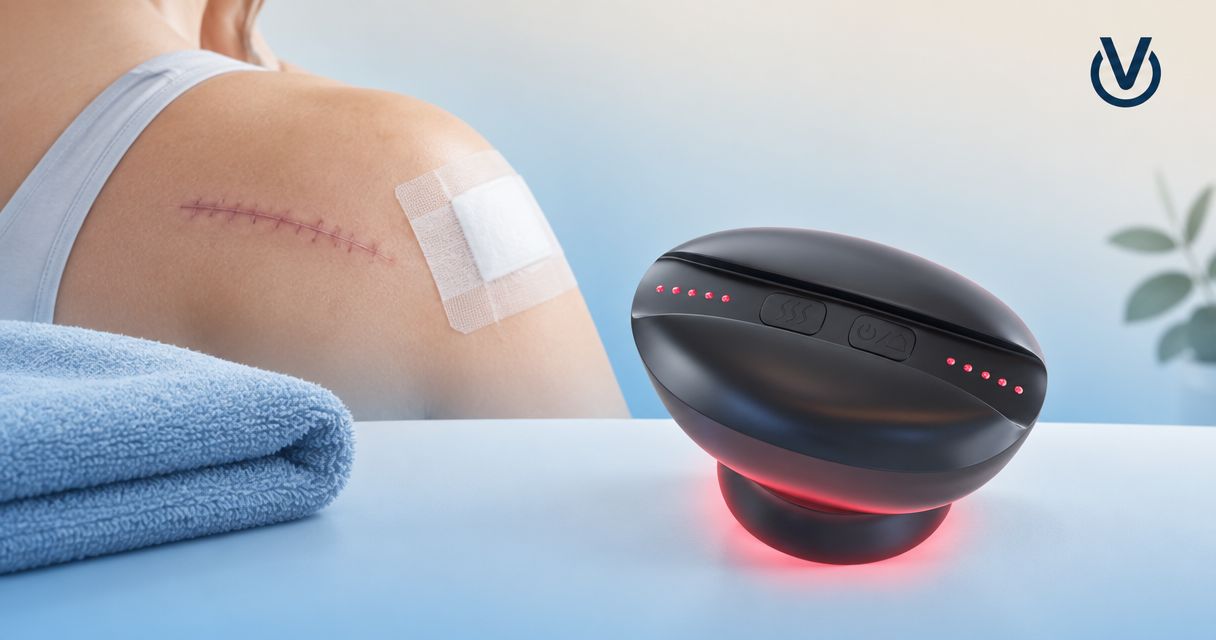
The Vazo Slide is the larger portable cupping device, combining cupping, heating, massage, and gua sha in a 4-in-1 format. Vazo Lume is the smaller portable cupping device. Both have a base made from medical-grade alloy; that describes the base material, not certification of the whole device or proof of medical outcomes.
| Device | Best for | Stated advantage | Limitation for this goal |
|---|---|---|---|
| Vazo Slide | Consumers seeking combined cupping, heating, massage, and gua sha functions | Multiple functions in a portable handheld device | Those functions do not establish posture correction |
| Vazo Lume | Consumers seeking the smaller of these portable cupping devices | Smaller format relative to Vazo Slide | Smaller size does not establish better posture outcomes |
Neither device replaces an assessment of persistent neck or back symptoms. For a 2026 purchase decision, prioritize the intended use and instructions over claims about straightening your spine.


When should you skip cupping and get assessed?
Do not use cupping to self-treat a new deformity, significant pain after an injury, or progressive weakness. New bladder or bowel dysfunction with back pain, or numbness around the groin, requires urgent medical care.
Seek medical advice for persistent or worsening pain, unexplained fever with back pain, or symptoms that interfere with ordinary activities. A visible change in spinal shape also deserves assessment rather than an assumption that your muscles simply need releasing.
For cupping itself, avoid broken, infected, or irritated skin. Ask a healthcare professional before treatment if you take blood-thinning medication, have a bleeding disorder, or have reduced skin sensation; heat and suction require particular care when you cannot reliably feel discomfort.
Can cupping permanently fix rounded shoulders?
Cupping is not established as a permanent fix for rounded shoulders. Temporary symptom relief does not demonstrate lasting changes in strength, movement habits, or spinal structure.
If shoulder position concerns you, start by clarifying whether the issue is appearance, discomfort, or limited function. Those goals call for different decisions.
Is exercise better than cupping for posture?
Exercise is the relevant tool when your goal involves building strength, practicing movement, or improving activity tolerance. Cupping cannot perform those tasks for you.
That does not make every posture exercise appropriate for everyone. Choose an individualized plan when symptoms persist, and keep passive treatments secondary to the activities you need to regain.
How many cupping sessions does posture correction take?
There is no established cupping-session count for posture correction. A promise that a treatment package will permanently realign your body is not supported by general evidence of temporary pain relief.
Set a functional goal instead. If cupping is not helping that goal, or it causes skin problems, reconsider it rather than increasing treatment intensity.
FAQ
Can cupping for posture straighten my back?
Cupping for posture is not an established way to straighten your back or correct spinal alignment. Get a pronounced or changing spinal curve assessed rather than treating it as ordinary muscle tension.
Can cupping help if my shoulders feel tight after desk work?
Cupping can provide temporary pain relief for some people, but evidence is limited. Address the desk task and persistent symptoms rather than assuming tightness proves that your posture is wrong.
Does cupping release the muscles that cause forward head posture?
Cupping is not established as a correction for forward head posture. Feeling looser after treatment does not prove that a particular muscle caused your resting head position.
Should I use stronger suction to get better posture results?
No, stronger suction is not an established route to better posture. Follow the device instructions and stop for burning, blistering, sharp pain, or worsening symptoms.
Are cupping marks proof that posture treatment worked?
No, cupping marks are not proof of posture correction. Judge an optional comfort treatment by function, symptom response, and skin tolerance rather than mark darkness.
Can I use a Vazocupping device instead of physical therapy?
A Vazocupping portable cupping device does not replace physical therapy assessment or an individualized rehabilitation plan. At-home cupping and active rehabilitation serve different purposes.
Should I stretch harder after cupping?
Do not stretch harder simply because cupping changes how an area feels. Keep movement comfortable and follow any exercise guidance provided by your clinician.
One last thing
A straighter-looking photograph is not the same as a better-functioning body. For your 2026 routine, choose an everyday activity you want to make easier, then judge each treatment by whether it helps that activity without creating another problem.
Use cupping as an optional comfort tool. Build your posture plan around movement, manageable tasks, and assessment when symptoms persist.