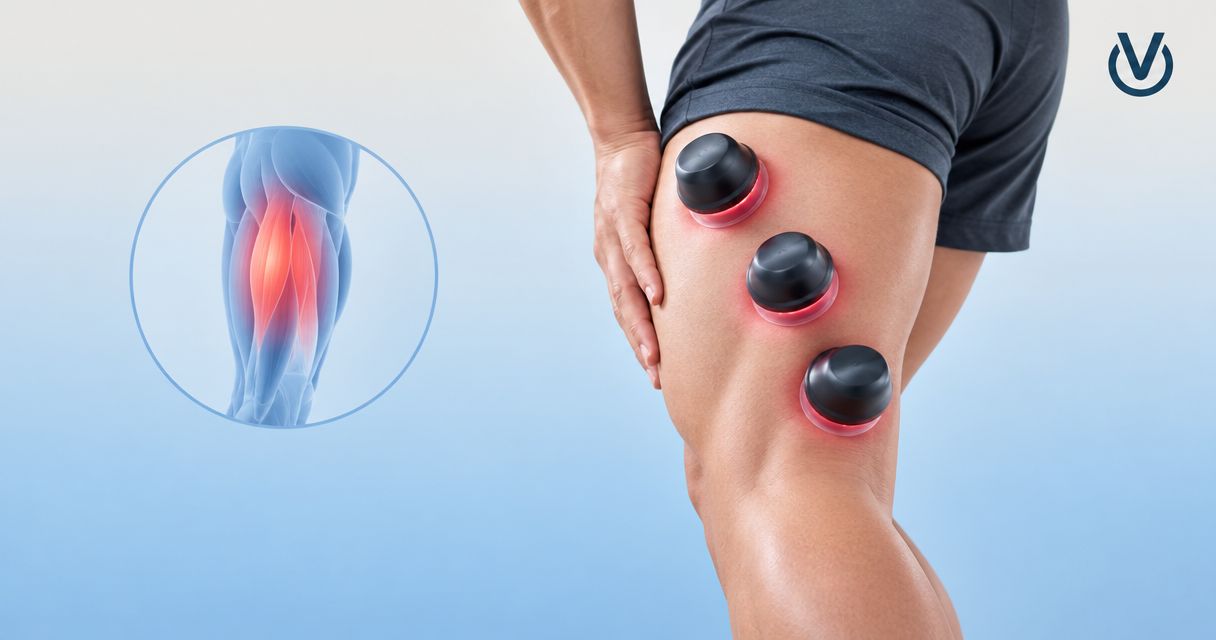
Do not use cupping directly on a newly pulled hamstring, especially when you have swelling, bruising, or sharp pain. Cupping for pulled hamstring recovery is not a substitute for assessment and rehabilitation; consider it only as an optional comfort measure after a qualified clinician confirms that the injured area is ready.
- Cupping for pulled hamstring recovery should wait until a clinician assesses the injury and clears the area.
- Suction and heat do not repair torn muscle fibers or establish readiness to return to sport.
- Vazo Cupping portable cupping devices belong in an optional wellness routine, not first aid for a fresh hamstring strain.
- A pop, substantial bruising, marked weakness, or difficulty walking calls for prompt medical assessment.
Can you use cupping on a pulled hamstring?
Not directly over a fresh or actively painful strain. A pulled hamstring involves injured muscle fibers, and sometimes tendon damage. Applying suction is not the same as treating the underlying injury.
For your 2026 recovery plan, separate immediate injury care from optional recovery tools. Our guide to using a heating cupping device on an injury addresses the related heat question, but your hamstring still needs an individual assessment.
| Your situation | Best next step | Where cupping fits | Main limitation |
|---|---|---|---|
| Sudden pain during sprinting, kicking, or stretching | Stop the activity and assess the injury | Avoid cupping the injured area | Suction does not establish injury severity |
| Bruising, swelling, a pop, or difficulty walking | Seek prompt clinical assessment | Do not self-treat with cupping | A significant muscle or tendon injury needs evaluation |
| Improving symptoms during prescribed rehabilitation | Follow your rehabilitation plan | Discuss an optional adjunct with your clinician | Feeling better does not prove restored strength |
| Persistent tightness after clearance | Review exercise load and recovery with your clinician | Consider only if specifically appropriate | Cupping does not replace progressive strengthening |
Why this matters
A hamstring that feels looser is not necessarily ready to sprint. Pain relief, tissue healing, and return-to-sport readiness are different outcomes, and a recovery tool cannot measure all three.
The National Center for Complementary and Integrative Health describes cupping research as generally low quality and says evidence for pain relief is not strong. That does not establish cupping as a treatment that repairs a hamstring tear or shortens recovery. Make rehabilitation the foundation; keep cupping optional.
What should you do immediately after pulling a hamstring?
Stop the movement that caused the pain. Do not test the injury with another sprint, force a deep stretch, or use a strong recovery treatment to see whether the pain disappears.
- Protect the injured area. Reduce activities that reproduce pain, particularly running, jumping, and forceful stretching.
- Check your symptoms. Notice whether you can walk normally and whether swelling, bruising, or weakness develops.
- Arrange assessment when needed. A sudden pop, substantial pain, or difficulty bearing weight warrants prompt medical attention.
- Follow an individualized rehabilitation plan. A clinician can guide comfortable movement, progressive loading, and eventual return to sport.
NHS guidance on hamstring injuries advises avoiding heat and massage during the early injury period. Heated or sliding cupping is therefore not an appropriate experiment on a newly painful hamstring.
For first aid in 2026, the decision is straightforward: do not add suction, scraping, or heat to an injury you have not assessed. An existing device routine does not make the injured area suitable for treatment.
Grade 1 hamstring strain: mild does not mean ready for cupping
A grade 1 strain involves limited muscle-fiber damage. You can still have pain and reduced function even when the injury appears relatively mild.
The American Academy of Orthopaedic Surgeons describes hamstring strains by severity, from mild injuries to complete tears. A grade label describes tissue injury; it is not permission to apply suction.
Best for a suspected mild strain: appropriate assessment and progressive rehabilitation. The benefit is a plan that addresses function, rather than only the sensation of tightness. The limitation is that progress still depends on how your hamstring responds to activity.
Do not grade the injury yourself because you can walk. Pain tolerance and walking ability alone do not establish the extent of muscle damage.
Grade 2 hamstring strain: a partial tear needs rehabilitation
A grade 2 strain is a partial tear. Pain, weakness, swelling, and bruising can interfere with walking and exercise, and the injury needs more than a comfort-focused recovery routine.
Best for a partial tear: clinician-directed rehabilitation. A structured plan can address movement and strength as recovery allows. Its limitation is that a generic exercise schedule cannot account for your particular tear, symptoms, or sport.
Cupping does not reconnect torn fibers. If a clinician later approves it for surrounding muscle discomfort, keep that purpose separate from treating the tear itself.
Grade 3 hamstring strain: a complete tear needs specialist assessment
A grade 3 strain is a complete muscle tear. Hamstring injuries can also involve a tendon pulling away from its attachment, which requires medical evaluation and sometimes surgery.
Best for a suspected complete tear: prompt specialist assessment, not home cupping. The priority is understanding which structures are injured and what treatment they require.
A pop, marked weakness, extensive bruising, or inability to walk normally should move you toward assessment. Do not wait for cupping marks or temporary pain relief to tell you whether the injury is serious.
Why the decision to use cupping varies
There is no universal day when cupping becomes appropriate after a hamstring strain. For 2026, use clinical readiness rather than a calendar shortcut.
- Injury severity: A mild strain and a complete tear require different management. Neither should be judged by soreness alone.
- Injury location: Pain in the muscle belly differs from pain near a tendon attachment. The location affects assessment and rehabilitation.
- Current symptoms: Increasing bruising, swelling, tenderness, or weakness argues against adding a local treatment.
- Skin condition: Broken, irritated, infected, or already injured skin is unsuitable for cupping.
- Medical history and medication: Blood thinners, bleeding disorders, impaired sensation, and circulation problems require specific clinical advice.
- The proposed technique: Stationary suction, sliding, scraping, and added heat create different exposures. Approval for one does not automatically cover the others.
Tell your clinician exactly what you intend to use. Asking whether gentle cupping on an uninjured surrounding area is appropriate is more useful than asking whether all massage is safe.
When can you consider cupping during rehabilitation?
Consider cupping only after the injury has been assessed and your treating clinician agrees that the proposed technique and location are appropriate. Clearance should address the actual device, whether heat is involved, and what symptoms mean you should stop.
An improving hamstring is not automatically ready for suction. If daily activity still increases pain or swelling, discuss that response before adding another intervention.
Ask these questions at your appointment:
- Is the painful area muscle, tendon, or something else?
- Should cupping stay away from the injured tissue entirely?
- Is heat inappropriate at this stage?
- What reaction means I should stop and contact you?
- Which exercises and functional checks matter more than symptom relief?
Do not copy another athlete's cupping settings or schedule. A routine intended for ordinary post-workout soreness is not a rehabilitation prescription for a tear.
If cupping is approved, follow the clinician's instructions and the device manual together. Stop for pain, burning, numbness, blistering, or worsening symptoms rather than treating those reactions as evidence that the session is working.
Does cupping help a hamstring heal faster?
Cupping is not established as a way to make a torn hamstring heal faster. General research on pain relief cannot demonstrate repair of torn muscle fibers, faster tendon healing, or earlier safe return to sport.
Keep that distinction clear when reading recovery claims in 2026. Increased comfort is a subjective outcome; restored strength and the ability to tolerate sport-specific loading require separate assessment.
Cupping also has drawbacks. It can leave temporary skin discoloration and cause soreness, burns, or infection, as described by the National Center for Complementary and Integrative Health. Those risks matter when the area is already bruised or painful.
If you try an approved adjunct, judge it by its limited purpose. Do not use a comfortable session as permission to skip rehabilitation or increase training.
Where a portable cupping device fits
Vazo Cupping portable cupping devices are best for consumers seeking an optional at-home wellness tool, not treatment for an acute hamstring tear. That distinction applies even when the device combines several functions.
The Vazo Slide is a portable cupping device combining cupping, heating, massage, and gua sha in a 4-in-1 format. Its base is made from medical-grade alloy; that description applies to the base material, not certification of the whole device or proof of injury-healing benefits.
For Vazo Cupping users, the practical advantage is having those functions in a handheld device. The limitation is equally important: neither portability nor the base material establishes that suction, heat, or scraping is suitable for your injured hamstring.
If your clinician approves a specific use, stay within that advice. Owning a multifunction device does not mean using every function on the same area or combining treatments during injury recovery.
Can you stretch or massage a pulled hamstring instead?
Do not force a newly pulled hamstring into a deep stretch or aggressive massage. Replacing cupping with another intense treatment does not solve the problem of loading freshly injured tissue.
Gentle movement and later stretching belong within a rehabilitation plan that responds to your symptoms. Strengthening also needs progression rather than an immediate return to your usual exercises.
Ask your clinician what you can do now, what should wait, and what response is acceptable afterward. Specific activity guidance is more useful than a blanket instruction to loosen the muscle.
When should you seek urgent medical help?
Seek prompt assessment for a pop followed by substantial pain, marked weakness, extensive bruising, or difficulty walking. Severe or worsening symptoms deserve evaluation even if you initially assumed the injury was minor.
Do not assume every painful back-of-thigh symptom is a pulled muscle. New leg swelling, warmth, or redness without a clear injury needs urgent medical advice because a blood clot is one possible cause.
Chest pain or shortness of breath with leg symptoms is an emergency. Do not massage or cup the leg while waiting to find out what is wrong.
FAQ
Can I use cupping on a pulled hamstring right away?
Do not cup directly over a newly pulled hamstring. Stop the activity that caused the pain and seek assessment if you have a pop, substantial bruising, weakness, or difficulty walking.
How many days after a hamstring pull can I start cupping?
There is no universal number of days that makes cupping appropriate after a hamstring pull. Your clinician should assess injury severity, current symptoms, skin condition, and the proposed technique before you start.
Does cupping repair a torn hamstring?
Cupping is not established as a treatment that repairs a torn hamstring. Any approved use should remain an optional adjunct rather than a replacement for rehabilitation.
Is heated cupping safe on a fresh hamstring strain?
Do not use heated cupping on a fresh hamstring strain. Early injury guidance advises avoiding heat and massage, and added suction does not make heat appropriate.
Can I cup around a bruised hamstring instead of over it?
Do not assume cupping beside a bruised hamstring is appropriate. Ask a clinician to identify an acceptable location and technique rather than choosing the placement yourself.
Can I run after cupping if my hamstring feels better?
Feeling better after cupping does not establish that your hamstring is ready for running. Return to activity should follow your rehabilitation plan and functional assessment, not temporary symptom relief.
Can I use Vazo Slide during hamstring recovery?
Use Vazo Slide during hamstring recovery only if your treating clinician approves the specific technique and location. It is a portable cupping device, not a treatment established to heal a hamstring tear.
One last thing
Before returning to running in 2026, ask a better question than whether your hamstring feels loose: can it tolerate the load your sport requires? Your rehabilitation professional can assess that progression; a cupping mark cannot.
Write down what triggers symptoms and how your hamstring responds to prescribed activity. Bring that record to your appointment instead of adding treatments whenever the muscle feels tight.