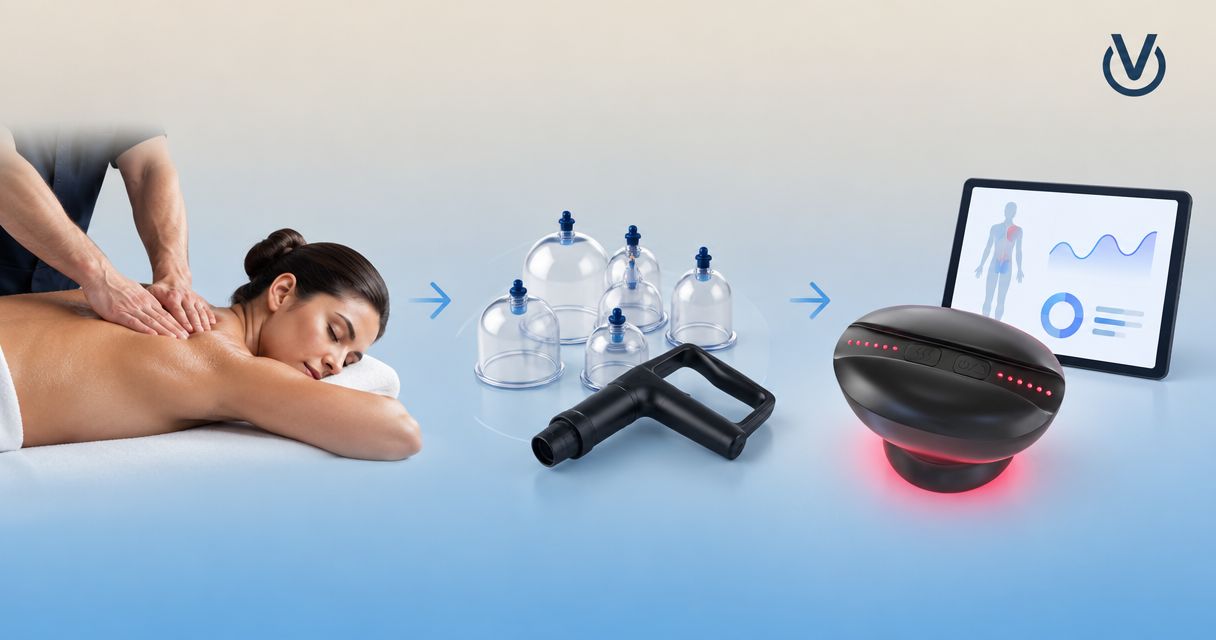
Instead of repeatedly working on the same tight area between deep tissue massages, use a deep tissue massage to cupping maintenance workflow that starts with your therapist’s guidance, checks skin recovery, and adds cupping only when appropriate. This 2026 guide shows you how to organize that handoff without treating stronger suction, extra heat, or darker marks as signs of better recovery.
- Deep tissue massage to cupping maintenance starts with recovered skin and your massage therapist’s guidance, not a fixed calendar.
- Vazocupping suits adults seeking portable cupping devices for an optional at-home routine, not diagnosis or injury treatment.
- Keep suction, heat, and session length within your device instructions; never increase intensity to chase marks.
- Track comfort and ordinary movement before repeating cupping on the same area.
Why this matters
Deep tissue massage applies manual pressure. Dry cupping applies suction to the skin. They are different techniques, and adding one after the other is not automatically better than using either alone.
Maintenance means making a considered decision between appointments—not repeating treatment whenever you notice tightness. Persistent or worsening symptoms need assessment rather than a more elaborate home routine.
Vazocupping sells the Vazo Slide portable cupping device, which combines cupping, heating, massage, and gua sha functions. Those functions give you choices; they do not establish that combining every function after a deep tissue massage improves results.
For your 2026 routine, separate the decisions: whether cupping belongs in your care, whether your skin is ready, and whether you can use the device as directed. A “not today” decision is a valid outcome.
Before you start
- Get a clear handoff. Ask your massage therapist which areas were treated, which should be left alone, and whether your symptoms warrant assessment by a licensed healthcare professional. Have your device’s instructions available before starting.
- Prepare the materials and access. Have a clean device, its specified cleaning supplies, any manufacturer-approved glide product, and a stable position that lets you reach and release the cup easily. Identify the suction-release procedure before attaching it.
- Catch the common gotcha: leftover tenderness. Comfortable movement does not prove that recently massaged skin is ready for suction. Do not cup bruised, broken, irritated, infected, or unusually tender skin, and do not apply suction directly over varicose veins.
If you take anticoagulants, have a bleeding disorder, reduced sensation, circulation problems, or another condition affecting skin healing, get medical advice before home cupping. Pregnancy also calls for individualized guidance rather than a general internet workflow.
These checks come before choosing a setting. A device’s controls cannot determine whether a symptom is ordinary soreness or an injury.
Configuration unit: your massage-to-home handoff
Establish the area and purpose
- Name the purpose. Write down what you want to monitor, such as comfort during an ordinary shoulder movement. Avoid goals such as breaking up scar tissue, treating inflammation, or correcting an undiagnosed injury.
- Map 1 body area for the initial plan. Use a plain description you can identify reliably. This is an organizational choice, not a prescribed treatment dose or permission to cup that area.
- Ask about restrictions. Tell your therapist you are considering an electric cupping device, including heat if you intend to use it. Ask whether the recently treated area should be left alone.
- Record the handoff. Note what to avoid and what symptoms should prompt a call. If your therapist cannot advise on the device, seek guidance from an appropriately qualified healthcare professional.
Expected result: You have a defined purpose and clear boundaries before picking up the device. If the only plan is “use it wherever it hurts,” the handoff is unfinished.
Choose the right maintenance route
Not every between-appointment routine needs cupping. Use this comparison to decide what belongs in your plan.
| Maintenance route | Best for | Practical advantage | Limitation |
|---|---|---|---|
| Therapist-guided movement and observation | People clarifying how symptoms respond between visits | Does not add suction or heat to recently treated skin | Does not replace assessment of persistent symptoms |
| At-home portable cupping | Adults cleared for self-use who can follow device instructions | Lets you organize a home routine around an accessible area | Adds skin-related risks and cannot diagnose the cause of pain |
| Professional reassessment | New, worsening, recurrent, or unexplained symptoms | Allows a qualified professional to evaluate the problem | Requires an appointment rather than an immediate home intervention |
Choose the least complicated route that fits the problem. Buying a device does not make it necessary to use it after every appointment.
Configuration unit: device and skin readiness
Check the device before skin contact
- Read the instructions for your exact model. Find the approved body areas, contraindications, suction controls, release method, session limits, and cleaning procedure. Do not transfer settings from another brand or model.
- Inspect the contact surfaces. Check for residue, damage, or anything that prevents normal contact. Do not use damaged equipment.
- Practice the release procedure off your body. Identify the manufacturer’s instructions for ending suction. Do not assume switching off and releasing suction are the same action.
- Select only permitted functions. Start with the manufacturer’s beginner guidance. Do not add heating or scraping simply because those functions are present.
Expected result: You know how to start, adjust, and end the session before the device touches your skin. If a control or instruction is unclear, resolve it first rather than experimenting on your body.
Vazocupping’s Vazo Slide is a portable cupping device with a base made from medical-grade alloy. That statement describes the base material only; it does not certify the whole device or establish a medical benefit.
Check the area, not just the calendar
A fixed waiting period cannot account for differences in massage pressure, skin response, health conditions, or the device used. Do not use an arbitrary countdown as permission to cup a tender area.
Before a session, inspect the skin in good light. Leave the area alone if it remains bruised, irritated, painful to light touch, or otherwise abnormal. Ask your treating professional when uncertainty remains.
Check sensation as well. Do not use heat or suction where you cannot reliably judge discomfort. Avoid areas excluded by your device instructions, even when online demonstrations show someone treating them.
Your 2026 setup should also pass a reach test: can you position the device, monitor the skin, and release suction without twisting or straining? If not, choose professional assistance rather than an improvised setup.
Configuration unit: a controlled maintenance session
Keep the first use interpretable
- Record 2 observations before starting: how the area feels at rest and how it feels during an ordinary, comfortable movement. Describe the experience without forcing a stretch or testing through pain.
- Prepare the skin as directed. Use only products and preparation methods permitted by the manufacturer. More oil is not automatically better, and an unapproved product is not a substitute for correct contact.
- Apply the manufacturer’s starting guidance. Keep suction and session length within the instructions. Do not borrow pressure levels or timings from social media.
- Monitor continuously. Stop for pain, burning, numbness, dizziness, blistering, or another unexpected reaction. Follow the release procedure rather than pulling an attached cup away from the skin.
- Finish without adding another technique. Do not immediately follow an uncomfortable session with deeper massage, scraping, or more suction to try to correct the feeling.
Expected result: You complete—or deliberately stop—a session without exceeding the instructions. Completion is not the goal when your skin or symptoms tell you to stop.
For a separate explanation of intensity decisions, read how much suction pressure is safe for cupping. A pressure setting is not a target to beat.
Use a small, useful session log
Your log needs enough detail to prevent accidental repetition, not enough fields to become a chore. Record the body area, functions used, settings, duration, and what happened afterward.
Use 3 checkpoints: before the session, immediately afterward, and before considering another session. These are observation points, not treatment intervals. At each checkpoint, note skin condition and whether ordinary movement feels different.
Keep the language neutral. “Shoulder felt unchanged during dressing” tells you more than “great recovery session.” Also record a stopped session; stopping because of discomfort is useful information for your next professional conversation.
Do not interpret darker marks as proof of effectiveness or “toxins leaving.” Cupping marks are a skin response, not a score for recovery. A photograph can document a reaction, but it cannot diagnose its cause.
Second variant: maintenance between recurring massage visits
If you already attend massage appointments regularly, build a feedback loop rather than repeating a fixed sequence after every visit. The same body area does not need the same intervention each time.
- Bring your observations to the next appointment. Show your therapist where you used cupping and describe any soreness, marks, or change in ordinary activity.
- Update the home plan. Ask whether the original target still makes sense and whether recurrent symptoms need a different assessment.
- Remove unnecessary steps. If cupping adds discomfort or complicates the picture, leave it out. Continue only the parts of your plan that your treating professional considers appropriate.
- Keep equipment care separate. Cleaning and inspection belong after use, even when the next session is undecided.
Expected result: Each appointment informs the next home decision. You are not stacking treatments simply because they appear on a calendar.
For your 2026 maintenance plan, review the routine when symptoms, medication, health status, or device instructions change. A previously comfortable session is not permanent clearance for every future situation.
Troubleshooting
The area is still tender after massage
Skip cupping on that area. Do not use suction to work through residual tenderness. Contact your therapist or healthcare professional if symptoms worsen, persist unexpectedly, or interfere with normal activity.
The cup will not maintain contact
Release it and check placement, skin preparation, contact surfaces, and any seals identified in the manual. Do not automatically increase suction to compensate for poor contact. Stop if the device appears damaged or does not operate normally.
Sliding catches or pinches
Stop and release suction using the specified procedure. Review whether sliding is permitted for that body area and whether your preparation matches the instructions. Do not drag an attached device through pain or add an unapproved lubricant.
Heat feels uncomfortable
Stop the session and follow the device’s shutdown and release instructions. Do not wait for burning to become tolerable. Blistering or a suspected burn warrants medical advice; a material description does not make excessive heat harmless.
Symptoms are getting worse rather than settling
Stop home treatment and seek assessment. New weakness, persistent numbness, substantial swelling, spreading redness, or severe pain should not trigger stronger suction. Sudden limb swelling or pain accompanied by chest pain or shortness of breath requires urgent medical attention.
Customize your workflow
Change the plan by simplifying it first. If you cannot tell which intervention caused a reaction, remove the optional cupping step and discuss the response with your treating professional.
Vazocupping’s portable cupping devices belong in a self-care decision, not a promise of medical results. The Vazo Slide’s combined functions offer different ways to use the device as directed, but that flexibility also requires you to keep track of what you actually used.
In 2026, make your maintenance goal easy to explain: preserve a clear picture of your symptoms, avoid repeatedly stressing irritated skin, and know when to ask for help. A routine you can describe accurately is more useful than a complicated sequence you cannot evaluate.
FAQ
Can I use cupping immediately after a deep tissue massage?
Do not automatically add cupping immediately after deep tissue massage. Check with your treating professional, follow your device instructions, and leave bruised, irritated, or tender skin alone.
How long should I wait between massage and cupping?
Use your skin response, symptoms, professional guidance, and device instructions rather than a universal waiting period. A countdown does not establish that an area is ready for suction.
Is deep tissue massage to cupping maintenance better than massage alone?
Do not assume that adding cupping makes massage maintenance better. The decision depends on whether cupping is appropriate for you and whether it adds discomfort or interferes with your care plan.
Is Vazo Slide suitable for an at-home maintenance routine?
Vazo Slide is a portable cupping device with cupping, heating, massage, and gua sha functions. Use it only within its instructions and your individual health guidance; it does not diagnose or treat the cause of unexplained pain.
Does medical-grade alloy mean the entire device is medically certified?
No. For Vazo Slide, medical-grade alloy describes the base material, not certification or regulatory approval of the whole device, and it does not establish a medical outcome.
Should I increase suction if cupping leaves no marks?
No. Marks are not a treatment target or proof of effectiveness. Keep settings within the instructions and stop if the session causes pain or another unexpected reaction.
Can I cup the same area every day between massage appointments?
Do not make daily use the default. Follow the device’s frequency guidance and avoid repeating cupping on bruised, tender, irritated, or otherwise abnormal skin.
One last thing
The most useful maintenance decision can be the session you skip. If a routine requires you to ignore tenderness, chase marks, or repeatedly increase intensity, stop and reassess it. Bring that pattern to your next appointment instead of trying to overpower it at home.