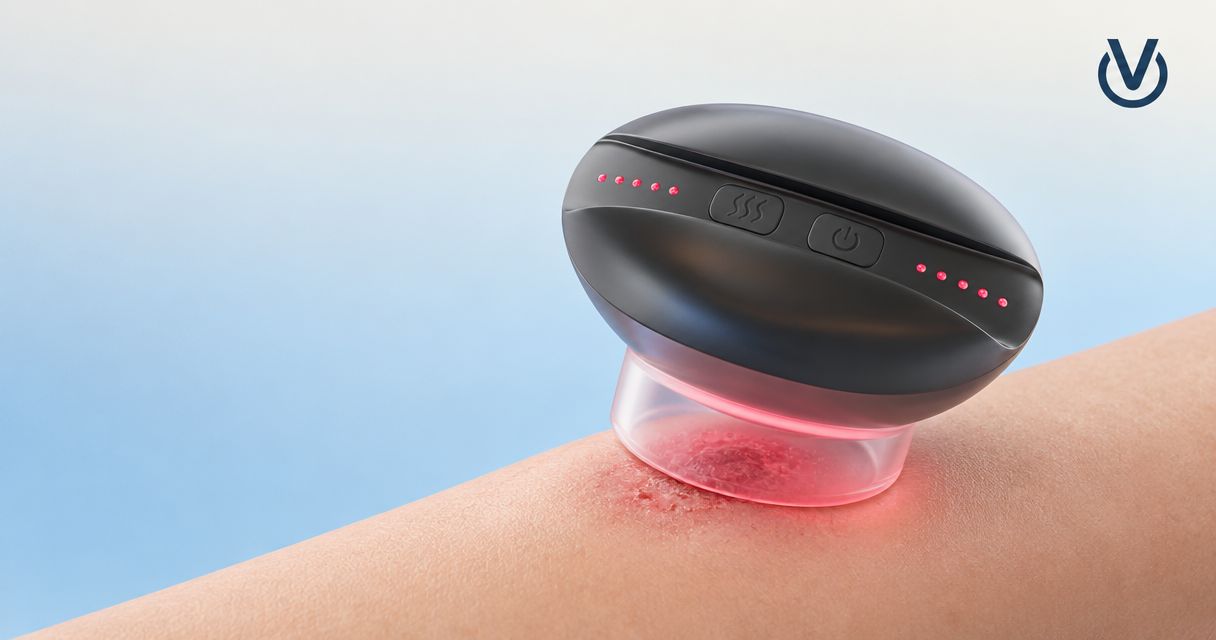
No—do not use a cupping device over broken skin, including cuts, scrapes, open blisters, cracked areas, or healing incisions. Suction can further injure damaged skin, and contact with a device can introduce contamination; lowering the setting or covering the wound does not make cupping over it safe.
- Never use a cupping device over broken skin, even with low suction or a bandage.
- Vazocupping portable cupping devices belong in an intact-skin wellness routine, not wound care.
- Skip scabs, open blisters, bleeding cracks, and surgical incisions; let the skin heal before reconsidering cupping.
- Stop immediately if cupping causes a skin tear, bleeding, blistering, burning, or sharp pain.
Can you use a cupping device over broken skin?
Broken skin is a reason to skip the area, not adjust the device. The concern applies whether you use a handheld electric device or a traditional suction cup. An opening in the skin changes the decision before suction strength, heat, or session length enters the picture.
Use this skin check before an at-home session in 2026:
| What you see | What to do | Why it matters |
|---|---|---|
| Cut, scrape, or bleeding crack | Do not cup over it | Suction and friction can further damage the area |
| Open or fluid-filled blister | Leave it alone | A blister roof protects the tissue underneath |
| Scab or recently reopened spot | Wait; do not test suction | A scab does not mean the skin beneath it is ready for mechanical stress |
| Surgical incision | Follow the surgical team's instructions | A closed-looking incision is not automatic clearance for cupping |
| Hot, swollen, draining, or increasingly painful skin | Seek medical advice rather than cupping | These changes can signal infection or another problem needing assessment |
| Intact skin without irritation | Check the remaining precautions and device instructions | Intact skin is necessary, but it does not make every location or person suitable |
Device hygiene remains essential, but clean equipment does not make an open wound a suitable cupping site. Keep cupping-device cleaning separate from the decision about whether your skin is ready.
Why this matters
Your skin forms a protective barrier. A scrape, split, or incision interrupts that barrier, while cupping adds suction and, with sliding techniques, friction. Applying those forces to injured skin can make the injury worse instead of supporting your recovery routine.
The National Center for Complementary and Integrative Health identifies burns, infections, scars, and persistent skin discoloration among possible adverse effects of cupping. Those risks are reasons to screen your skin before treatment—not reasons to chase stronger suction or darker marks.
For your 2026 recovery routine, make skin condition the first decision. A planned session is optional; protecting an injured area takes priority.
What counts as broken skin before cupping?
Broken skin includes more than a wound that is actively bleeding. Small surface injuries still matter when a cup pulls on the surrounding tissue or a sliding device passes across them.
Check the entire intended contact area, including where the cup rim will sit and where you plan to move it. Do not place the opening beside a scrape while allowing the rim to press across it.
Cuts, scrapes, and shaving nicks
Skip cuts, grazes, and shaving nicks, even when they look minor. If shaving has left stinging, irritated skin, postpone cupping over that area rather than using suction to test its tolerance.
A lack of bleeding is not proof that the skin is intact. Look for raw patches, splits, and spots that sting during ordinary washing.
Blisters, burns, and peeling skin
Do not cup over a blister, whether the surface is intact or already open. Suction can damage the blister roof, exposing the sensitive tissue underneath.
Avoid burns and sunburned skin as well. Peeling, tenderness, blistering, or ongoing redness are reasons to leave the area out of your routine, not add heat or massage.
Scabs, cracked skin, and irritated patches
A scab is a protective covering during healing. Pulling on it with suction or dragging a device across it can disturb that covering and reopen the area.
Cracked eczema, scratched rashes, and other inflamed patches also need a pause. If you have an ongoing skin condition, ask your clinician whether cupping is appropriate rather than treating each flare as an ordinary muscle-recovery issue.
Why the risk varies—but the stop rule does not
The extent of a skin injury changes the care it needs. It does not create a safe suction setting for an open wound. These factors deserve particular attention:
- Depth and extent: A deep cut, gaping wound, or large injured area needs different care from a superficial scrape. Neither belongs under a cup.
- Signs of infection: Increasing warmth, swelling, drainage, spreading redness, or worsening pain calls for assessment, not another session.
- Heat and friction: Heated or sliding techniques add stresses beyond suction. Turning off heat does not remove the risks from suction or contact.
- Healing conditions: Diabetes, poor circulation, and reduced sensation can complicate wound healing or make injury harder to notice. Discuss cupping with your clinician.
- Bleeding risk: Blood-thinning medicines and bleeding disorders need individual advice before cupping, even when the skin looks intact.
- Recent procedures: Surgery, stitches, and other skin procedures come with aftercare instructions that take priority over a wellness routine.
Do not use comfort as your only safety check. Reduced sensation can prevent you from noticing excessive heat or tissue stress promptly.
What should you do if cupping breaks your skin?
Stop the session immediately. Bleeding, a skin tear, or a new blister is an injury—not a sign that cupping is working more deeply.
Use this sequence for a minor surface injury. Seek medical care instead if the injury is deep, extensive, or difficult to assess.
- Release the suction. Use the device's release method rather than pulling an attached cup off by force. Stop heat and movement as well.
- Check the injured area. Look for bleeding, an open blister, a tear, or a burn. Do not apply another cup to investigate the painful spot.
- Provide basic wound care. Wash your hands, rinse a minor wound with clean running water, and use gentle direct pressure for bleeding. Protect it with a clean dressing when appropriate.
- Get help when needed. Seek prompt care for uncontrolled bleeding, a deep or gaping wound, a significant burn, spreading redness, pus, fever, or worsening pain.
- Set the equipment aside. Follow the manufacturer's cleaning instructions before any future use. Do not move a device contaminated with blood or wound fluid onto another area or another person.
Do not restart cupping because the bleeding has stopped. For a 2026 home-care checklist, put skin injury ends the session ahead of every setting or technique instruction.
Can you cup over a bandage or around a wound?
Do not cup over a bandage covering broken skin. A dressing protects the injury; it does not make the tissue underneath ready for suction. The cup can pull on the dressing and surrounding skin without giving you a clear view of what is happening below it.
Do not use tape, petroleum jelly, or extra lubricant as a workaround. None changes the underlying reason to avoid the injured area.
Cupping elsewhere also requires judgment. Keep the entire contact and movement area away from the wound, dressings, and irritated surrounding skin. There is no universal clearance distance that makes every injury safe to work around.
If the wound is infected, extensive, related to surgery, or healing poorly, ask your clinician before resuming cupping. Choosing another spot does not resolve those concerns.
When can you resume cupping after broken skin heals?
Resume only after the skin is fully closed and healed, with no scab, drainage, bleeding, or ongoing irritation. Surface closure alone is not clearance after surgery or a significant injury. Your clinician's instructions take priority.
Do not set a restart date from a generic online timetable. Wound depth, location, infection, circulation, and your health all affect healing. A small scrape and a surgical incision do not share a reliable waiting period.
Before you reconsider cupping in 2026, check that:
- The skin is intact throughout the intended contact area.
- No scab, blister, crack, or raw patch remains.
- Ordinary touch and movement do not cause wound pain.
- There is no drainage, increasing warmth, swelling, or spreading redness.
- Any clinician-imposed restrictions have been addressed.
These checks are screening steps, not permission to treat a recent scar. For an incision, follow the separate guidance on cupping after surgery and speak with your surgical team before applying suction nearby.
Does the device's material change the broken-skin rule?
No material description makes a consumer cupping device appropriate for open wounds. A smooth base, a clean surface, or an adjustable setting does not remove the mechanical stress of suction on damaged skin.
Vazocupping offers Vazo Slide and Vazo Lume as portable cupping devices. Their bases are made from medical-grade alloy; that description applies to the base material, not certification or regulatory approval of the entire device.
| Portable cupping device | Stated distinction | Best suited to | Important limitation |
|---|---|---|---|
| Vazo Slide | Larger device with cupping, heating, massage, and gua sha functions | Consumers seeking those functions in an at-home routine on suitable, intact skin | Not for cupping over broken skin; extra functions do not change that restriction |
| Vazo Lume | Smaller portable cupping device | Consumers prioritizing the smaller device format | Smaller size does not make damaged skin a suitable treatment area |
Vazocupping portable cupping devices are best suited to consumers seeking at-home cupping on intact skin, not wound care. Portability supports a home routine, but it does not replace skin checks, device instructions, or medical advice when an injury is present.
Is a cupping mark the same as broken skin?
No—a flat color change beneath an intact surface is different from a cut, blister, or skin tear. Cupping can leave discoloration without opening the skin, but a mark's darkness does not measure treatment quality or establish a health benefit.
Check the surface, not just the color. Bleeding, weeping, a raised fluid-filled blister, or a raw patch means the skin needs attention. Do not dismiss those changes as ordinary cupping marks.
Avoid repeatedly treating an already bruised or tender area. If a mark becomes increasingly painful, hot, swollen, or otherwise concerning, stop cupping and get medical advice.
FAQ
Can I use a cupping device over broken skin if the cut is tiny?
No—do not use a cupping device over broken skin, even when the cut is tiny. Suction or sliding contact can further injure the area; wait until it has healed.
Is the lowest suction setting safe over a scab?
No—the lowest suction setting does not make cupping over a scab safe. Leave the scab undisturbed and wait until the skin beneath it has healed.
Can I put a cup over a bandage covering a scrape?
No—do not place a cup over a bandage covering a scrape. The dressing does not make the injured tissue underneath suitable for suction.
What should I do if my cupping device causes a blister?
Stop cupping immediately and leave the blister intact. Seek medical advice for a significant or painful blister, a suspected burn, or signs of infection.
How many days should I wait before cupping a healed cut?
There is no universal waiting period for cupping after a cut. Wait until the skin is fully healed, and get individual advice for deep wounds, surgical incisions, or delayed healing.
Does a medical-grade alloy base make cupping safe over a wound?
No—a medical-grade alloy base does not make cupping over a wound safe. The material description does not establish wound-care suitability or certification of the entire device.
Is bleeding during home cupping normal?
Bleeding is a reason to stop ordinary at-home dry cupping immediately. Release suction, assess the injury, and seek care if bleeding does not stop with direct pressure or the wound is significant.
One last thing
A device can hold suction on skin that should not be treated. A good seal tells you about contact, not whether the tissue is healthy enough for cupping.
Make your final 2026 check simple: inspect first, then decide whether to start. If the surface is broken, blistered, scabbed, or irritated, skip the area. Protecting your skin is part of recovery—not an interruption to it.